

The Caspian Corridor: Russia's Hidden Leverage in the Expanding US-Israel-Iran Conflict


The Caspian Sea, a landlocked body of water bordered by Russia, Iran, Azerbaijan, Kazakhstan, and Turkmenistan, was long considered an isolated backwater, a "closed environment where monitoring is both impractical and currently of lower priority for global enforcement," as one sanctions expert described. For decades, the five littoral states presented the sea as a special zone: closed to outside military interference, governed by cooperation, and protected by agreements meant to preserve peace and regional balance.
That order has been shattered.
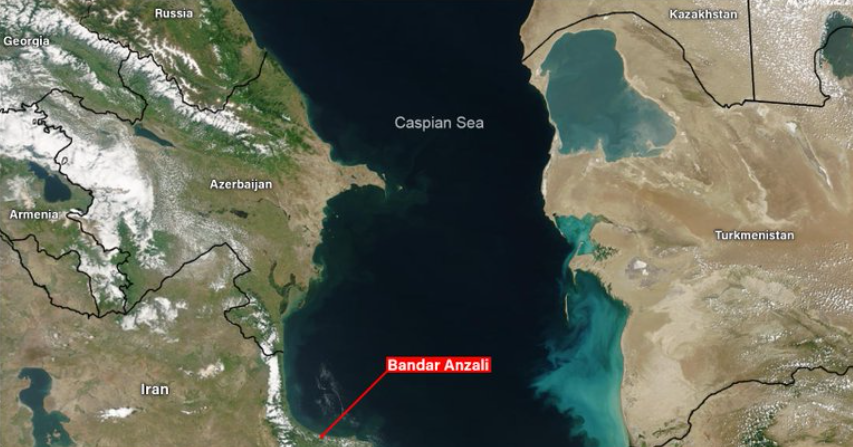
On March 18, Israel launched its first-ever missile strike on the Caspian Sea, targeting Iran's Bandar Anzali port. The attack destroyed multiple naval vessels, a command center, a shipyard, and critical port infrastructure. The IDF confirmed that one frigate, four missile boats, and numerous patrol vessels were eliminated. The strike expanded the war's maritime arena far beyond the Persian Gulf and the Strait of Hormuz, reaching a region previously untouched by such attacks.
This was not a random act of escalation. It was a calculated surgical strike aimed at severing a vital military supply line—the Caspian corridor through which Russia and Iran have been exchanging weapons, ammunition, and drone technology for years.
The Quiet Artery of the Axis
The Caspian Sea connects Russian ports such as Astrakhan with northern Iranian ports including Bandar Anzali and Amirabad. From there, cargo moves onward by rail or road toward the Persian Gulf and the Indian Ocean. Until the March 18 strike, this route had functioned as a relatively secure trade channel that bypassed traditional maritime chokepoints and sanctions enforcement, shielded from direct Western oversight and largely controlled by littoral states.
The scale of military traffic is staggering. In 2023 alone, ships transported more than 300,000 artillery shells and approximately one million rounds of ammunition from Iran to Russia. Since August 2024, Iran has provided Russia with over 400 Shahed-series drones, most of which have been used to strike Ukrainian critical infrastructure. The vessel BALTIYSKIY-111, a general cargo ship operating under the Russian flag, has been specifically identified as transporting Shahed-136/131-type UAVs, including parts, components, and materials, from Iran to Russia via the Caspian Sea, all while engaging in AIS dark activity—switching off tracking systems to conceal its movements. Iranian ships have routinely done the same, transferring cargo between Anzali, Amirabad, and Astrakhan in a coordinated evasion of international sanctions.
The route's importance has only intensified. Cargo volumes through Bandar Anzali tripled over the past year. There are reasons to believe this is one of the key channels for sanctions evasion.
The Reverse Flow: When the Supplier Becomes the Recipient
What makes the current moment uniquely dangerous is a dramatic reversal in the direction of military aid. For the first time, Russia is now sending weapons back to Iran—specifically, Russian-made versions of the very drones Tehran originally supplied to Moscow.
Western intelligence assessments, cited by the Financial Times, indicate that Russia has begun a "phased shipment of drones, medicine and food to Iran" following the initial US and Israeli strikes that began on February 28. Deliveries are expected to be completed by the end of March. The New York Times and The Guardian have run similar reports, citing European intelligence agencies that believe Russia is preparing to deliver drones to Iran for use in the war against the United States and Israel.
The drones in question are the Geran-2—Russia's domestically produced, upgraded version of the Iranian Shahed-136. Russian factories, including the massive Alabuga facility, now produce thousands of Geran-2 drones per month, having reverse-engineered and improved upon the original Iranian design. These Russian-made drones, equipped with improved communications, navigation, and targeting systems developed from Russia's battlefield experience in Ukraine, are now being funneled back to Iran via the same Caspian corridor.
Ukrainian President Volodymyr Zelenskyy confirmed this reverse flow, stating that drone shipments are currently traveling in the opposite direction—Russia sending Iranian-designed drones produced on Russian territory to Iran. As one Western official told the Financial Times, Moscow is stepping in not only to boost Iran's fighting capabilities but also to underwrite the broader political stability of the Tehran regime.
Beyond Drones: Russia's Full-Spectrum Assistance
Russia's support for Iran extends far beyond drone shipments. Western intelligence has confirmed multiple layers of assistance that collectively represent a significant escalation in the Moscow-Tehran axis.
First, intelligence sharing. The Washington Post reported that Russia has shared intelligence about the location of US military assets in the region, including aircraft and warships, with Tehran. This targeting data directly enables Iranian strikes against American forces.

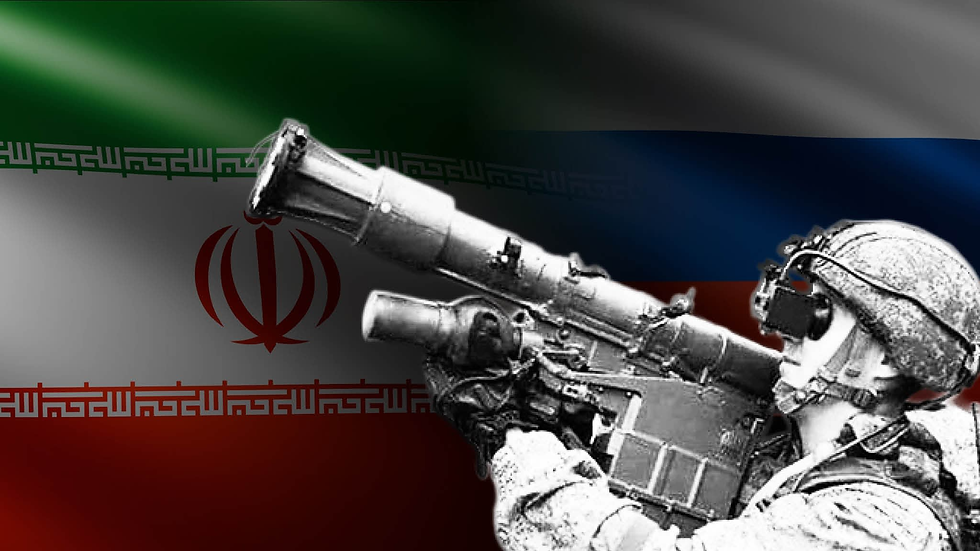
Second, air defense systems. Iran has secured a deal for the delivery of 500 man-portable Verba launch units and 2,500 9M336 missiles over a three-year period. However, Russia has so far turned down Iranian requests for the S-400 system, fearing it could heighten tensions with Washington, though operating the S-400 would effectively place Russian crews in a position where they could be directing fire against US aircraft.
Third, tactical and electronic warfare guidance. British defense chief John Healey declared that "there's an axis of aggression between Russia and Iran," accusing Moscow of "sharing tactics, training, and tech" to help Tehran fight the United States and Israel. According to Healey, this assistance commenced prior to the US and Israeli attack on February 28.
Why the Caspian Strike Was Different: Moscow's Uneasy Reaction
The international response to the Bandar Anzali strike revealed a critical geopolitical fault line. Russia issued direct and forceful criticism, while Azerbaijan, Kazakhstan, and Turkmenistan remained cautiously silent.
Russia's reaction was notably sharp. Foreign Ministry spokeswoman Maria Zakharova condemned the strike, describing the port as an important trade and logistics hub for food and civilian goods, a framing that conspicuously omitted any mention of the military cargo moving through it. Foreign Minister Sergey Lavrov, in a call with his Iranian counterpart, said any spread of war into the Caspian would create "unacceptable risks" for Russian personnel and could bring "catastrophic environmental consequences."
The reason for Moscow's alarm is clear. The strike carried two messages: first, that "there are no safe havens anywhere in Iran," demonstrating that attacks could reach well beyond the country's southern coast. Second, it signaled that Israel—and implicitly the United States—was closely monitoring the links between Iran and Russia across the Caspian, including the movement of sanctions-prohibited goods and weaponry through northern ports.
The old Caspian order, built on rhetoric about keeping outside powers out and preserving the basin as a peaceful regional space, has already been weakened in practice by Russian-Iranian military and logistical cooperation. That is why Moscow reacted so strongly: its own influence and transport corridor were directly challenged.
The Collateral Damage: Azerbaijan, Kazakhstan, and the Middle Corridor
For the other Caspian littoral states, the expanding conflict presents an excruciating dilemma. Azerbaijan, in particular, finds itself trapped between irreconcilable pressures.
Baku supplies approximately 40-50 percent of Israel's oil needs, mostly transported via the Baku-Tbilisi-Ceyhan pipeline. In return, Israel has provided Azerbaijan with billions of dollars worth of cutting-edge military technology that proved decisive in the 2020 and 2023 Nagorno-Karabakh wars. Yet Iran is Azerbaijan's southern neighbor, and any spillover of hostilities could be catastrophic.
The threat is not theoretical. On March 5, Iran launched a drone strike on the passenger terminal of Nakhchivan's airport, a direct act of aggression against Azerbaijani territory. Iranian media has also reported that Israel may have utilized Azerbaijani airspace, particularly over the Caspian Sea, to launch strikes on Tehran.
Under the 2021 Shusha Declaration, Azerbaijan and Turkey have formalized a broad security partnership that stipulates mutual military support if either country's independence or territorial integrity is threatened. In the event of a wider war with Iran, Baku would almost certainly turn to Ankara for military assistance.
But escalation carries enormous economic risk. Azerbaijan holds strategically vital energy assets in the Caspian Sea that ensure the flow of oil and gas to Europe through the $35 billion Southern Gas Corridor. A prolonged war with Iran could jeopardize this entire infrastructure. More immediately, the US-led TRIPP (Trump Route for International Peace and Prosperity)—a strategic transit corridor through Armenia's Syunik province and the Nakhchivan exclave—faces significant security challenges given its adjacency to Iran.
Kazakhstan, too, is watching with alarm. Astana has significantly deepened cooperation with Central Asian nations while actively promoting the Caspian basin as a "safe haven for transit" to attract greater European investment. Both Azerbaijan and Kazakhstan have voiced concerns with the recent escalation, even as Iran has demanded they respond with a "firm stance." Neither wants to publicly criticize the US and Israel.
The Enzac Assessment: No Winners in a Caspian Conflict
The strategic picture is clear. Moscow and Tehran will very probably continue to use the Caspian route for arms transfers. The corridor has proven too valuable for both regimes to abandon. Consequently, Israel may resort to additional strikes against Iranian naval assets, port infrastructure, and command centers along the Caspian coast.
There is plenty of room for escalation, and no room for winners.
If Russia continues to escalate its assistance, sending not only drones but potentially more sophisticated weaponry to Iran, the conflict could draw in additional regional powers. If Iranian strikes on Azerbaijani territory continue, Baku may be forced to invoke the Shusha Declaration, bringing Turkey into the equation. If the Caspian becomes a sustained combat zone, European energy security and the entire Middle Corridor trade route could be destabilized.
For the investor and the strategic observer alike, the key takeaway is this: the Caspian Sea is no longer a backwater. It has become a critical artery in the axis between Moscow and Tehran, a sanctions-evasion superhighway, and now—for the first time—a direct theater of war. The March 18 strike on Bandar Anzali was not an aberration. It was a preview of a new phase in a conflict that shows no sign of de-escalation.


Comments